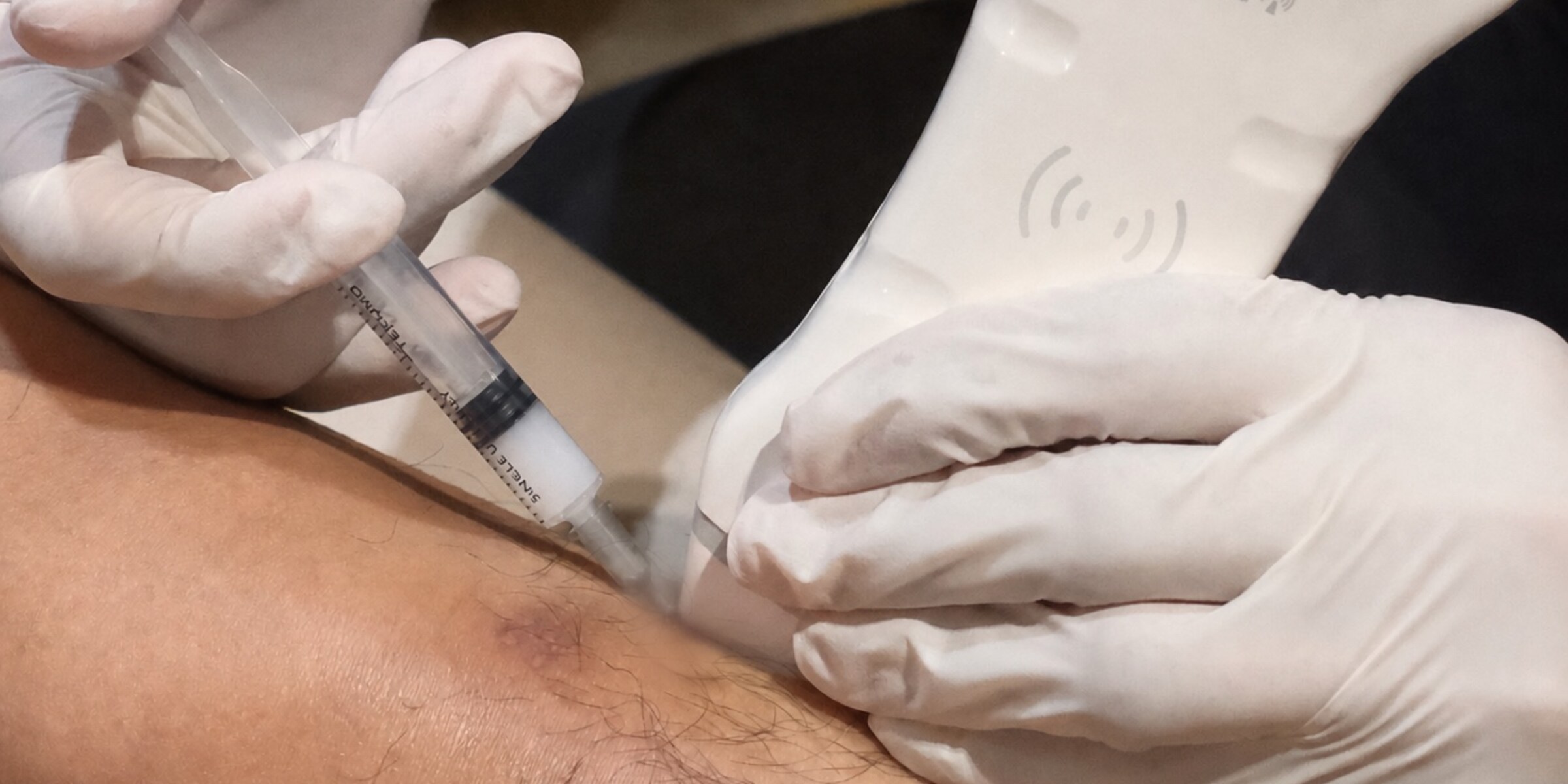
Ultrasound-Guided vs Blind Injection: Why Accuracy Is Worth It

When people say an injection "did not work," the medicine is rarely the problem — placement usually is. A dose delivered near the right spot behaves very differently from one delivered exactly into it. This is the whole case for ultrasound guidance, and it is worth understanding before you decide.
What a "blind" injection means
A blind injection is given using surface landmarks, anatomy knowledge, and the clinician’s feel for the tissue — without live imaging. In experienced hands it can work well for easy, superficial targets. But for deeper joints, small spaces, or structures sitting close to nerves and vessels, even a skilled estimate can miss the intended spot.
What guidance adds
Ultrasound shows the joint, the surrounding tissue, and the needle itself live on screen. The clinician watches the tip travel to the precise target and confirms the medicine spreads where intended. The benefits are practical and add up:
Accuracy
The dose reaches the exact target more often.
Reliability
Relief becomes more predictable.
Comfort
Less repeated probing to find the spot.
Safety
Sensitive nerves and vessels are seen and avoided.
- Needle and target seen live on screen
- Placement confirmed into the exact space
- Nerves and vessels avoided
- Reliable, repeatable accuracy
- Relies on surface landmarks and feel
- Placement estimated, not confirmed
- Best only for easy, shallow targets
- Accuracy varies attempt to attempt

The bottom line
Guidance does not change the medicine — it makes sure the medicine arrives. That is why, for most joint and tendon injections, accuracy is well worth it.
Which one is right for you?
Not every injection requires imaging, and your clinician will recommend the simplest approach that gives a reliable result. For deeper or more precise targets — and whenever certainty matters — ultrasound guidance is the sensible choice. The decision is always made together, as part of an assessment-led plan rather than a one-size answer.
Frequently asked questions
Is a blind injection unsafe?
Not inherently — for easy, superficial targets it can work well. Guidance simply adds certainty and is preferred for deeper joints or areas near sensitive structures.
Does guidance make the injection more expensive?
There can be a difference depending on the procedure. The value is in fewer wasted attempts and more reliable relief — your clinic can explain the specifics for your case.
How do I know which I am getting?
Just ask. A good clinic will explain why a particular approach is recommended for your specific target before anything is done.
Talk to a Respire specialist
A clear assessment and a practical plan — for knee pain, sport injury, or office syndrome.